
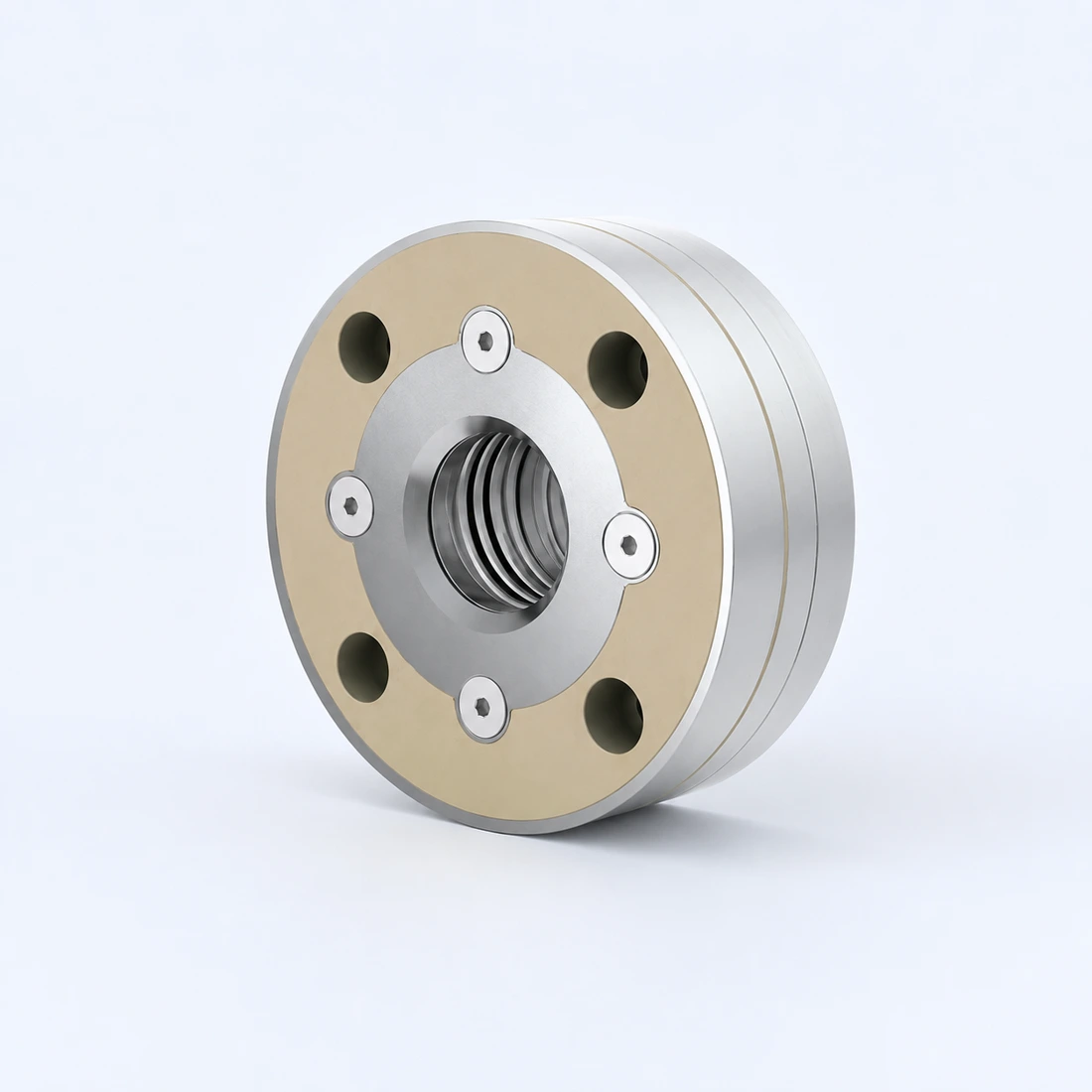
XAFS in situ cell
Rechargeable-battery cell
Transmission measurements on rechargeable batteries; the source design is intended for synchrotron use.
- Function
- Designed for synchrotron transmission / XAS / imaging of Li-ion, Na-ion and solid-state batteries.
- Beam path / detection
- Opposing Kapton windows transmit the beam through the electrode / separator / electrolyte stack.
TECHNICAL SPECIFICATIONS
Specifications and configuration
- Function
- Designed for synchrotron transmission / XAS / imaging of Li-ion, Na-ion and solid-state batteries.
- Beam path / detection
- Opposing Kapton windows transmit the beam through the electrode / separator / electrolyte stack.
- Atmosphere
- Assembly in an inert-atmosphere glovebox limits moisture and oxygen exposure.
- Sealing / structure
- Two flanges clamp a central chamber with O-ring seals.
- Sample mounting
- Aligned electrode stack; electrode leads connect to a potentiostat.
- Applications
- Cathode evolution, lithium insertion, SEI formation, solid-electrolyte interfaces and battery failure analysis.
Materials, windows, temperature control and interfaces are selected for the experiment. Confirm instrument compatibility and the final technical agreement.
LABORATORY PLANNING
Prepare your laboratory
- Compatibility
- Confirm beam geometry, cell mounting, window material, sample thickness and instrument clearance.
- Utilities
- Match gas, liquid, electrical and heating / cooling connections to the experiment.
- Installation review
- Confirm sealing, material compatibility and operating limits with the technical team.
Cell requirements depend on the selected materials, interfaces and host instrument.
RESOURCES & SUPPORT
Explore Rechargeable-battery cell
Match the system to your sample, measurement target and laboratory.