
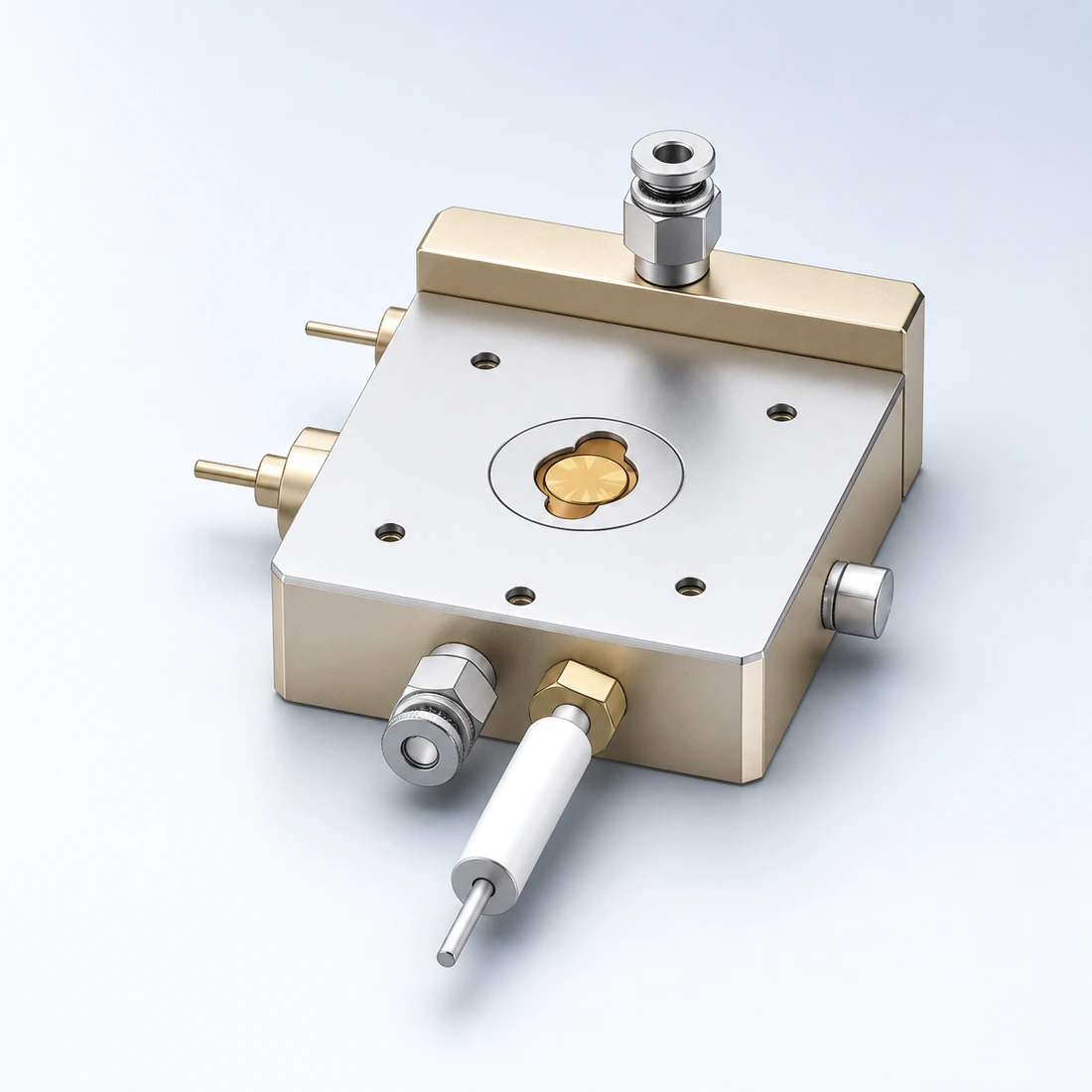
XRD in situ cell
Three-electrode XRD electrocatalysis cell
Three-electrode control with XRD monitoring of catalyst phase and structure.
- Function
- Three-electrode control for OER, HER, ORR or CO₂RR with XRD phase and structure monitoring.
- Beam path / detection
- Transmission or grazing incidence at the catalyst layer for diffraction measurements.
TECHNICAL SPECIFICATIONS
Specifications and configuration
- Function
- Three-electrode control for OER, HER, ORR or CO₂RR with XRD phase and structure monitoring.
- Beam path / detection
- Transmission or grazing incidence at the catalyst layer for diffraction measurements.
- Electrochemistry
- Working, counter and reference electrodes connect through insulated side-wall feedthroughs.
- Atmosphere
- Inert / reactive gas or vacuum; static or circulating electrolyte.
- Sealing / structure
- Square flange chamber with top / side windows and O-ring or metal-gasket sealing.
- Sample mounting
- Catalyst-coated electrode or carbon paper is centered in the XRD beam.
Materials, windows, temperature control and interfaces are selected for the experiment. Confirm instrument compatibility and the final technical agreement.
LABORATORY PLANNING
Prepare your laboratory
- Compatibility
- Confirm beam geometry, cell mounting, window material, sample thickness and instrument clearance.
- Utilities
- Match gas, liquid, electrical and heating / cooling connections to the experiment.
- Installation review
- Confirm sealing, material compatibility and operating limits with the technical team.
Cell requirements depend on the selected materials, interfaces and host instrument.
RESOURCES & SUPPORT
Explore Three-electrode XRD electrocatalysis cell
Match the system to your sample, measurement target and laboratory.