
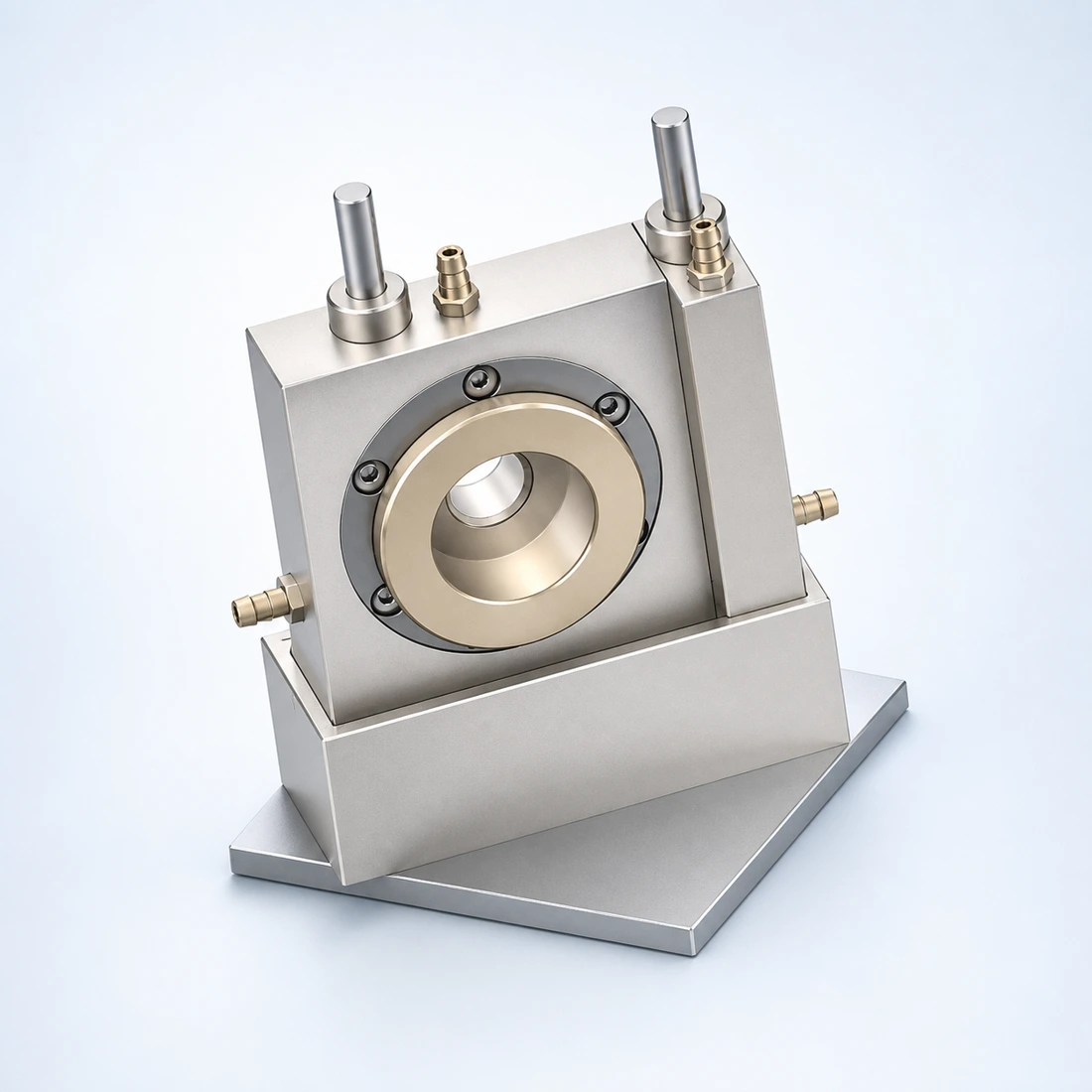
XAFS in situ cell
Dual-chamber XRD–XAFS electrochemical cell
Separate working- and counter-electrode chambers with transmission and fluorescence geometries.
- Function
- Separate working- and counter-electrode chambers with independent circulation; convertible to single-chamber operation.
- Beam path / detection
- Synchrotron XAFS in transmission / fluorescence and XRD in transmission; 45° cell rotation for fluorescence.
TECHNICAL SPECIFICATIONS
Specifications and configuration
- Function
- Separate working- and counter-electrode chambers with independent circulation; convertible to single-chamber operation.
- Beam path / detection
- Synchrotron XAFS in transmission / fluorescence and XRD in transmission; 45° cell rotation for fluorescence.
- Dual chambers
- Each chamber has an inlet / outlet pair; unused ports are plugged in single-chamber mode.
- Electrode arrangement
- Reference electrode shares the working-electrode chamber; counter-electrode liquid thickness is fixed.
- Electrolyte
- Aqueous systems including strong acids and bases such as H₂SO₄, HClO₄ and KOH.
- Base / sealing
- 0°/45° rotating base with leak-control design; adjustable working-electrode liquid thickness.
Materials, windows, temperature control and interfaces are selected for the experiment. Confirm instrument compatibility and the final technical agreement.
LABORATORY PLANNING
Prepare your laboratory
- Compatibility
- Confirm beam geometry, cell mounting, window material, sample thickness and instrument clearance.
- Utilities
- Match gas, liquid, electrical and heating / cooling connections to the experiment.
- Installation review
- Confirm sealing, material compatibility and operating limits with the technical team.
Cell requirements depend on the selected materials, interfaces and host instrument.
RESOURCES & SUPPORT
Explore Dual-chamber XRD–XAFS electrochemical cell
Match the system to your sample, measurement target and laboratory.