
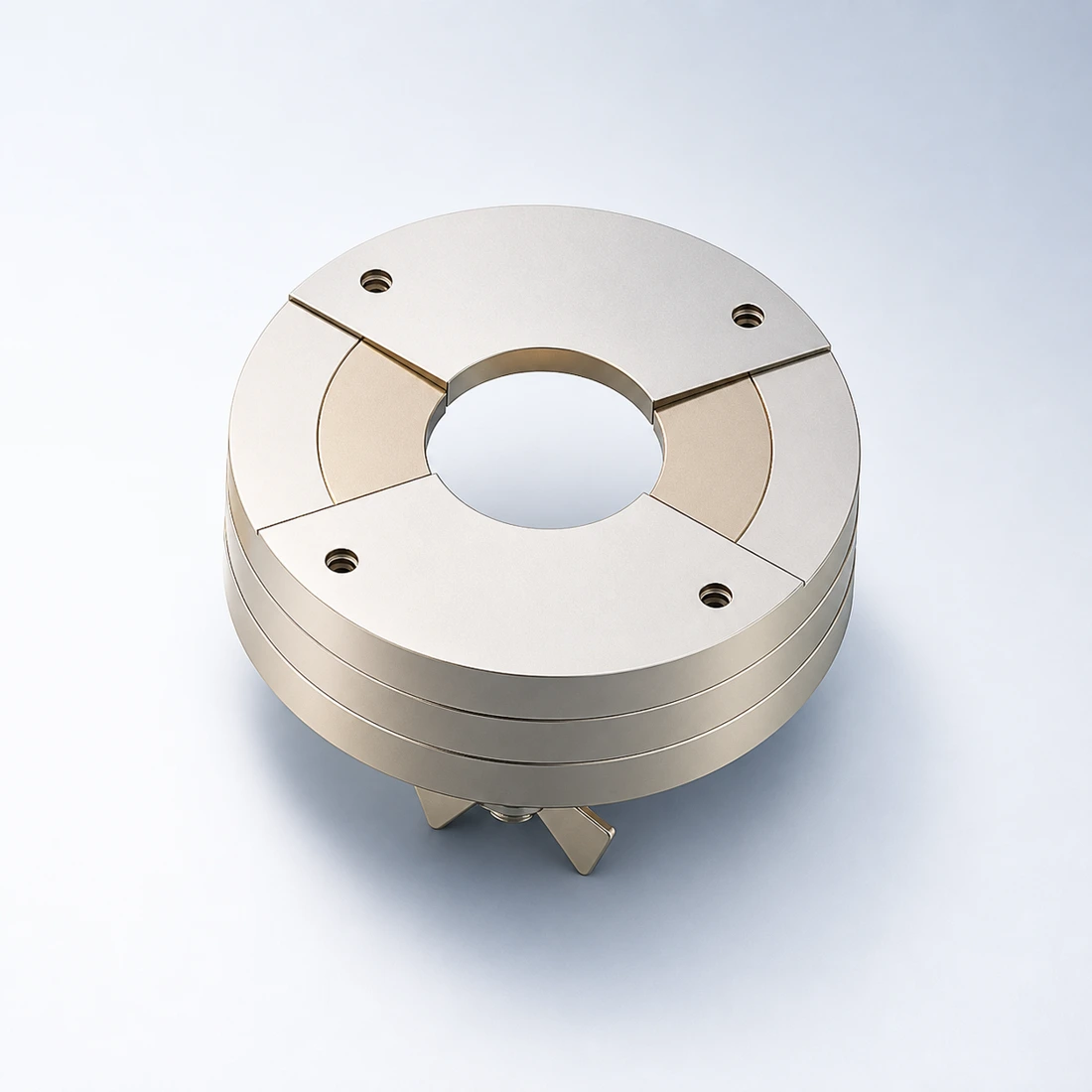
XRD in situ cell
XRD battery cell
In situ XRD during battery cycling, with optional heating and water cooling.
- Function
- In situ battery cycling with XRD phase tracking; optional heating and water cooling.
- Beam path / detection
- A central single window for incident / outgoing X-rays; commonly Kapton or Be to reduce background.
TECHNICAL SPECIFICATIONS
Specifications and configuration
- Function
- In situ battery cycling with XRD phase tracking; optional heating and water cooling.
- Beam path / detection
- A central single window for incident / outgoing X-rays; commonly Kapton or Be to reduce background.
- Electrochemistry
- Two electrodes with insulated leads through the side or bottom to a potentiostat.
- Atmosphere
- Glovebox assembly; optional vacuum / gas ports for an inert atmosphere.
- Sealing / structure
- Disc-flange body with O-ring or metal-gasket seal; concentric window and battery chamber.
- Sample mounting
- Centered cathode / separator / anode stack; spacer or chamber sets thickness.
Materials, windows, temperature control and interfaces are selected for the experiment. Confirm instrument compatibility and the final technical agreement.
LABORATORY PLANNING
Prepare your laboratory
- Compatibility
- Confirm beam geometry, cell mounting, window material, sample thickness and instrument clearance.
- Utilities
- Match gas, liquid, electrical and heating / cooling connections to the experiment.
- Installation review
- Confirm sealing, material compatibility and operating limits with the technical team.
Cell requirements depend on the selected materials, interfaces and host instrument.
RESOURCES & SUPPORT
Explore XRD battery cell
Match the system to your sample, measurement target and laboratory.