
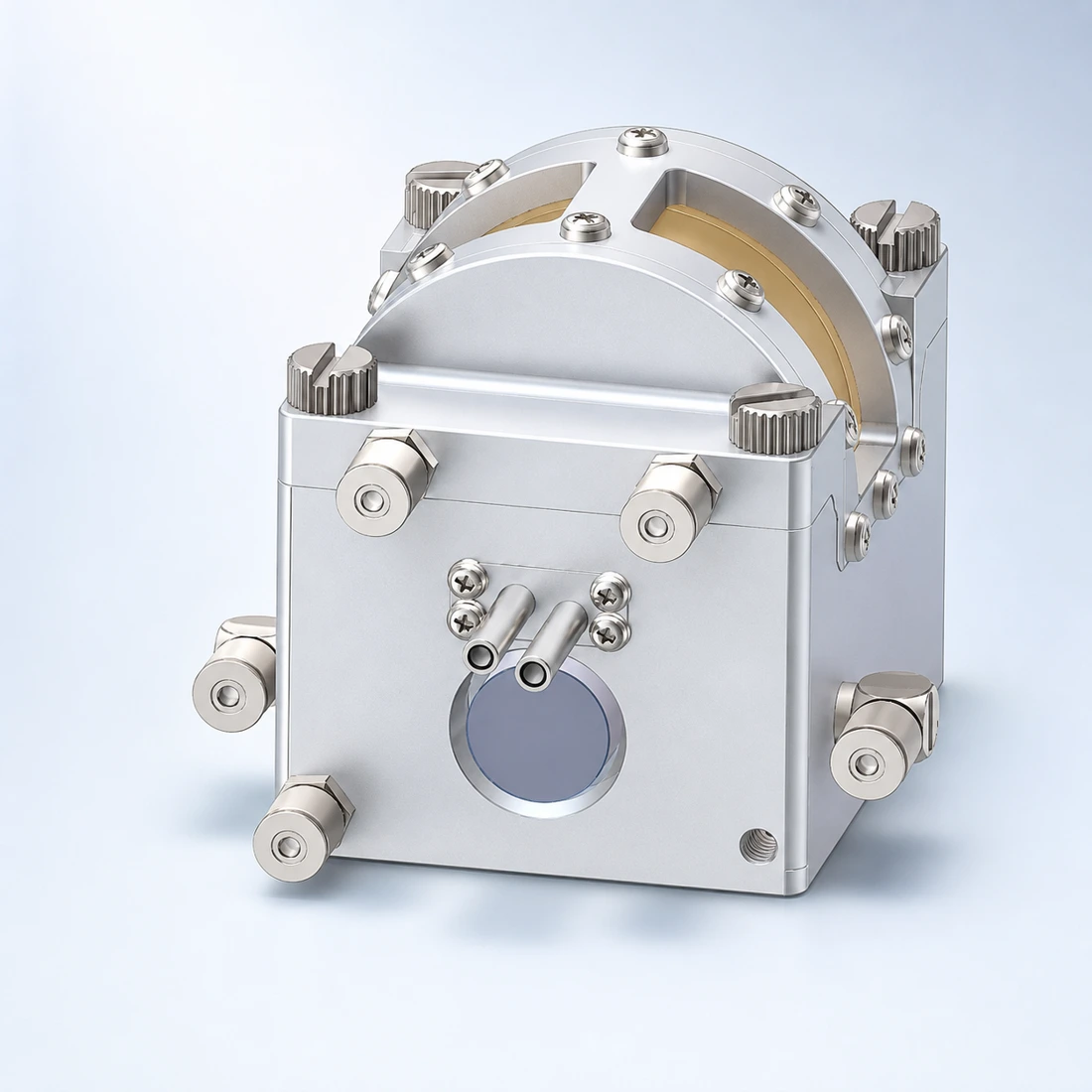
XRD in situ cell
High / low-temperature XRD cell
XRD characterization from −196 to 600°C under controlled gas or vacuum.
- Function
- Powder, film or bulk-sample XRD from −196 to 600°C under controlled gas or vacuum.
- Beam path / detection
- Transmission or reflection geometry; Kapton, quartz, sapphire or Be window options.
TECHNICAL SPECIFICATIONS
Specifications and configuration
- Function
- Powder, film or bulk-sample XRD from −196 to 600°C under controlled gas or vacuum.
- Beam path / detection
- Transmission or reflection geometry; Kapton, quartz, sapphire or Be window options.
- Temperature control
- Heater rods / wires and K/S thermocouples; cryogenic cold finger / cooling channels and PID control.
- Atmosphere
- Inert or reactive gas; optional vacuum port. Request vacuum specifications.
- Sealing / structure
- Thermal chamber with graphite / metal C-ring / copper seals for heating and indium / metal seals for cooling.
- Sample mounting
- Sample stage or heating block centers the sample in the beam and uniform-temperature zone.
Materials, windows, temperature control and interfaces are selected for the experiment. Confirm instrument compatibility and the final technical agreement.
LABORATORY PLANNING
Prepare your laboratory
- Compatibility
- Confirm beam geometry, cell mounting, window material, sample thickness and instrument clearance.
- Utilities
- Match gas, liquid, electrical and heating / cooling connections to the experiment.
- Installation review
- Confirm sealing, material compatibility and operating limits with the technical team.
Cell requirements depend on the selected materials, interfaces and host instrument.
RESOURCES & SUPPORT
Explore High / low-temperature XRD cell
Match the system to your sample, measurement target and laboratory.